How were the Pyramids built? | Egypt Wonders Tours
culture
How were the Pyramids built?
Discover how the ancient Egyptians built the Pyramids without modern machinary. Explore the latest archeological evidance, engineering theories, and fascinatings facts about the Pyramids of Giza.
Egypt Wonders Team
September 4, 2026
22 min read
Why the Pyramids Still Puzzle the World?
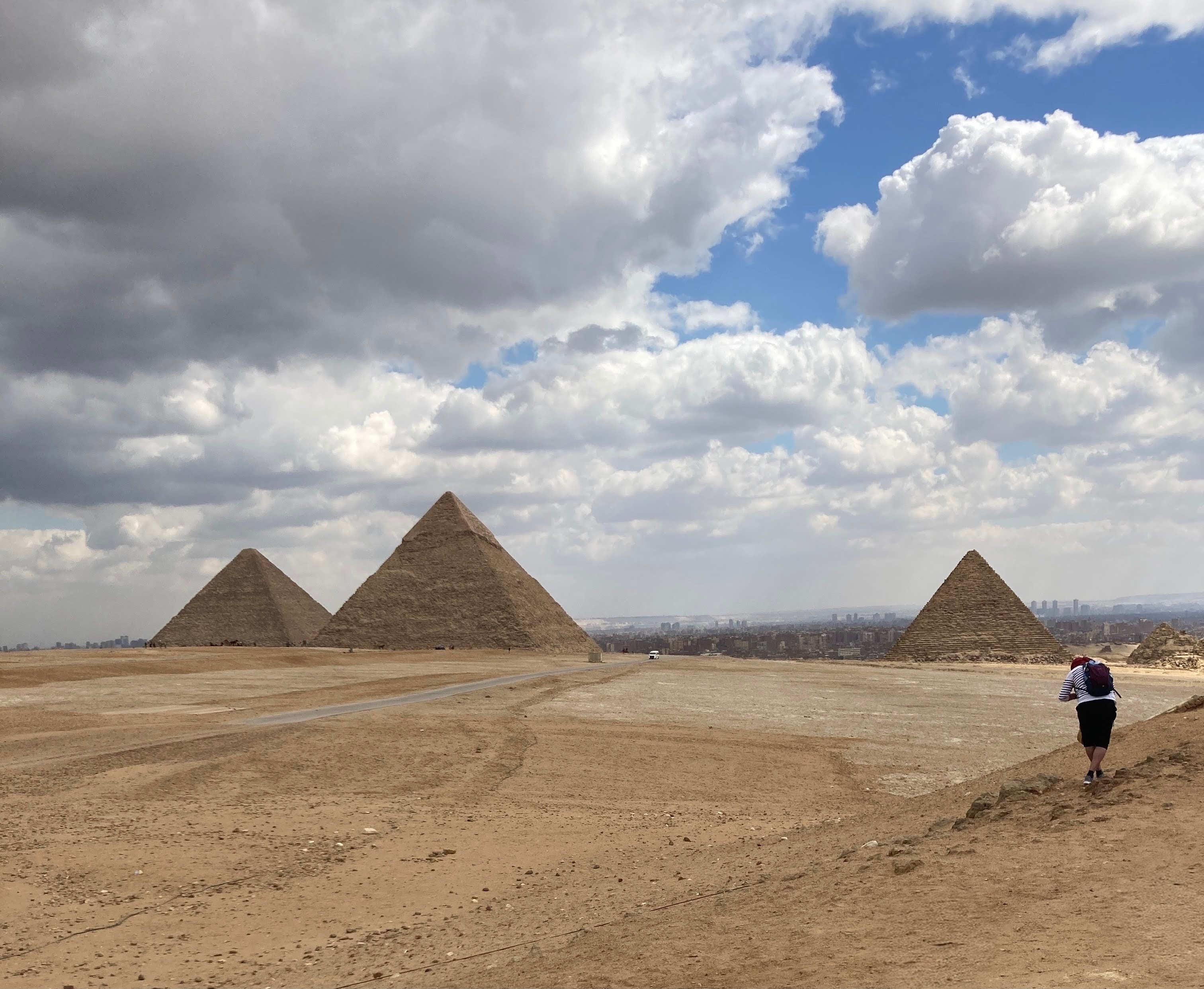
For more than 4,500 years, the pyramids of Egypt have inspired wonder, debate, and countless theories. Some believe they were built by advanced civilizations or even extraterrestrials. Yet the real story is far more impressive.
The Great Pyramid of Khufu stands as a masterpiece of human ingenuity, careful planning, and extraordinary craftsmanship. Modern archaeology continues to uncover evidence that reveals how thousands of skilled workers created one of history's greatest engineering achievements.
More than 2.3 million limestone blocks were used
to build the great Pyramid was built with remarkable precesion and with exceptional alignment with the cardinal directions.
How was this accomplished without cranes or modern machinery?
How Were the Pyramids Really Built? The Engineering Secrets Behind Ancient Egypt’s Greatest Achievement
The pyramids of Egypt have stood as some of the most extraordinary monuments ever created.
When visitors stand in front of the Great Pyramid of Giza for the first time, one question almost always comes up:
How did the ancient Egyptians build something this enormous without modern cranes, trucks, or construction machinery?
The answer is not a single invention or a lost piece of technology. It was a combination of engineering, mathematics, surveying, quarrying, transportation, organization, and an enormous amount of human skill.
The more archaeologists discover about pyramid construction, the more impressive the real story becomes.
The pyramids were not built by aliens, nor does the archaeological evidence support the popular idea that they were constructed by vast armies of slaves. Instead, they were built by an organized workforce of craftsmen, laborers, engineers, quarry workers, boatmen, architects, and administrators working together under an exceptionally sophisticated system.
So, how were the pyramids really built?
Let's look at what archaeology can tell us.
#Egyptian Pyramids#Giza Pyramids
Experience Egypt
Ready to turn this story into your next journey?
Book hand-crafted, zero-friction private tours led by local expert guides across Egypt.
The Great Pyramid: An Extraordinary Engineering Achievement
The Great Pyramid was built for Pharaoh Khufu, the second king of Egypt's Fourth Dynasty, around the 26th century BCE.
When completed, it stood approximately 146.6 meters (481 feet) high, making it the tallest human-made structure in the world for thousands of years.
Its original polished limestone casing made the monument even more spectacular, reflecting sunlight and giving the pyramid a brilliant, almost white appearance.
The pyramid is estimated to contain roughly 2.3 million stone blocks, although the exact number remains debated.
The average block is relatively manageable compared with the enormous stones found in some parts of the monument, but certain granite blocks used inside the pyramid weigh many tons.
And this raises the obvious question:
How could ancient Egyptians quarry, transport, lift, and position millions of stones with such extraordinary precision?
The answer begins long before the first stone was placed.
Who Actually Built the Pyramids?
One of the most persistent myths about the pyramids is that they were built by slaves.
Archaeological discoveries around Giza tell a different story.
Excavations have uncovered evidence of a large settlement associated with the workers who constructed the pyramids. Archaeologists have found bakeries, food-production facilities, workshops, living quarters, storage areas, and evidence of organized administration.
The workers also appear to have received substantial food supplies, including bread, beer, fish, and meat.
Evidence from workers' cemeteries is particularly important.
The presence of tombs belonging to people involved in pyramid construction demonstrates that these workers were not simply disposable laborers. Some received respectable burials close to the monument they helped build.
This does not mean that every worker was necessarily a highly paid professional. Pyramid construction required different levels of labor, from highly skilled craftsmen and supervisors to agricultural workers who may have joined the workforce seasonally.
The important point is that the evidence reveals a highly organized Egyptian workforce, not the Hollywood image of endless chains of slaves.
The Pyramid's Project - Stone Quarries & Transport
Where Did the Stone Come From?
Building a pyramid begins with one basic problem:
Where do you get millions of tons of stone?
Fortunately for the ancient Egyptians, the Giza Plateau itself is made largely of limestone.
Much of the core material could therefore be quarried relatively close to the construction site.
But the Egyptians wanted more than a massive pile of rough stone.
They wanted a monument with smooth, precise surfaces.
For this reason, high-quality limestone was transported from Tura, on the eastern side of the Nile, for the outer casing.
Even more impressive were some of the granite blocks used inside the Great Pyramid.
Granite was transported from Aswan, hundreds of kilometers south of Giza.
Moving such heavy material over this distance required an advanced transportation system.
And that brings us to one of the most important pieces of the puzzle: the Nile.
The Nile Was Ancient Egypt's Greatest Transportation Highway
The Nile was not simply the source of life for ancient Egypt.
It was also its greatest transportation network.
Large stone blocks could be loaded onto boats and transported along the river and through waterways toward the pyramid construction zone.
Ancient Egyptians were highly experienced boat builders and sailors. They understood how to take advantage of the Nile's currents, winds, and seasonal flooding.
Archaeological discoveries have provided evidence for waterways and harbors associated with pyramid construction.
Recent research has also strengthened the idea that ancient waterways once extended much closer to the pyramids than the modern landscape suggests.
This meant that instead of transporting every block across land from distant quarries, the Egyptians could use the Nile system to move heavy materials much of the way.
That dramatically changed the logistical challenge.
How Were the Stones Cut?
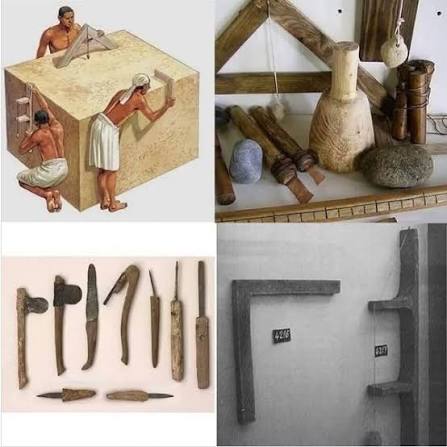
The ancient Egyptians did not have steel saws, electric drills, or modern quarrying equipment.
They worked primarily with tools made from stone, copper, wood, and other materials available during the period.
For softer limestone, copper tools could be useful, particularly when combined with abrasive materials.
For harder stone such as granite, the Egyptians used techniques involving dolerite pounding stones and abrasive materials.
Quarrying was not simply about cutting a perfect block from the rock.
Workers first had to identify suitable stone, separate it from the bedrock, shape it, and prepare it for transportation.
The enormous scale of this operation required careful organization.
Imagine repeating that process not hundreds of times, but hundreds of thousands of times.
How Did They Move the Massive Stones?
This is where one of the most fascinating pieces of evidence comes into the story.
The ancient Egyptians used wooden sledges to transport heavy objects across land.
A famous scene from the tomb of Djehutihotep at Deir el-Bersha shows a large statue being pulled on a sledge while a worker pours liquid in front of it.
Experiments have demonstrated that wetting sand can reduce the resistance encountered by a sledge.
This does not mean the Egyptians simply poured water everywhere and dragged pyramid blocks effortlessly.
The real process would have involved carefully prepared surfaces, coordinated teams of workers, sledges, ropes, and supervisors.
It was an exercise in logistics and physics using relatively simple technology.
Plumb lines
Measuring rods
Levels
Right angles
Sight lines
Water-based leveling techniques
How the Pyramids were built - Theories & Evidence:
1- The Great Ramp Mystery
Once the stones reached Giza, another problem appeared:
How do you get a huge stone block higher and higher as the pyramid grows?
This is one of the most debated aspects of pyramid construction.
Archaeologists have proposed several possible ramp systems.
1-1: Straight Ramps
One possibility is a large straight ramp extending from the ground toward the pyramid.
Workers could pull blocks upward using sledges.
The problem is scale.
A ramp capable of reaching the upper levels of the Great Pyramid would have needed to become extremely long and would have required enormous quantities of construction material.
For this reason, many researchers believe that a single massive straight ramp probably does not explain the entire construction process.
2-1: Zigzag or Switching Ramps
Another possibility is that ramps were constructed in a zigzag pattern along one or more sides of the pyramid.
This would reduce the required length compared with a single straight ramp.
Such a system could have been adapted as the pyramid became taller.
3-1: Spiral Ramps
Some theories propose that ramps may have wrapped around the outside of the pyramid.
A spiral arrangement would allow workers to continue raising blocks without requiring one enormous straight ramp.
However, the archaeological evidence for a complete external spiral ramp at Giza remains uncertain.
Could There Have Been an Internal Ramp?
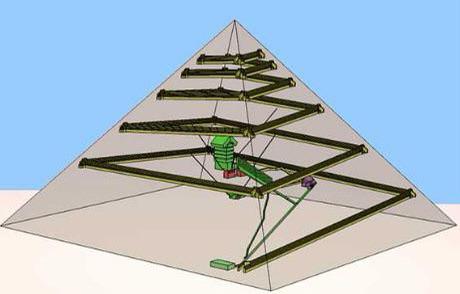
One of the most interesting modern theories is the idea that part of the transportation system may have existed inside the pyramid's structure.
French architect Jean-Pierre Houdin proposed an internal ramp theory, suggesting that an internal ramp system could have been used to move blocks upward as the pyramid grew.
The theory is intriguing because it attempts to solve some of the problems associated with enormous external ramps.
However, it remains a theory rather than an established fact.
This distinction is important.
When discussing ancient Egypt, we should separate what archaeology has demonstrated from what researchers are still debating.
The pyramids are fascinating enough without turning theories into facts.
How Did They Lift the Stones?
Ramps were probably not the only technology involved.
The ancient Egyptians understood the principle of the lever, which could have helped move and position blocks.
Instead of lifting a massive stone directly into the air, workers could raise it gradually, using wooden levers and supporting material.
The process may have involved many small movements rather than one dramatic lift.
A few centimeters at a time can accomplish remarkable things when thousands of workers are coordinated.
This is one of the key lessons of pyramid construction:
The Egyptians did not need one miraculous machine. They needed a system that worked.
How Did They Make the Pyramid So Straight?
Perhaps even more impressive than the size of the Great Pyramid is its precision.
The monument is remarkably well aligned with the cardinal directions.
Its four sides are oriented toward north, south, east, and west with extraordinary accuracy.
How did the ancient Egyptians accomplish this?
They had sophisticated knowledge of astronomy and surveying.
The Egyptians could observe the movement of stars across the night sky and use celestial observations to establish directions.
They also had practical surveying instruments and methods involving:
Plumb lines, Measuring rods, Levels, Right angles, Sight lines, Water-based leveling techniques.
They did not need modern laser equipment to establish a straight line.
They needed mathematics, observation, experience, and careful repetition.
How Did They Make the Base Perfectly Level?
Before constructing the pyramid, the builders had to prepare its enormous foundation.
A monument more than 140 meters high cannot tolerate a badly uneven base.
One proposed technique involves using water to establish a level reference.
Because water naturally settles to a horizontal surface, channels or trenches containing water could have helped identify variations in the bedrock.
Workers could then cut down high areas and fill or level lower areas.
The final result was an astonishingly precise foundation.
This may be one of the least glamorous parts of pyramid construction, but it was among the most important.
Before the Egyptians could build upward, they had to get the ground right.
Construction Time-frame & Labor:
How Long Did It Take to Build the Great Pyramid?
Ancient Egyptian sources and modern calculations suggest that the Great Pyramid may have taken roughly two decades or more to complete.
The exact timeline remains uncertain.
Herodotus, writing more than two thousand years after Khufu's reign, reported a construction period of 20 years, although his account should be treated carefully because he lived many centuries after the pyramid was built.
Modern estimates vary, but a construction period of approximately 20–30 years is commonly considered plausible.
That means the builders would have needed to quarry, transport, shape, and position enormous quantities of material continuously.
The scale of the operation is extraordinary.
How Many People Built the Great Pyramid?
There is no universally accepted number.
Older popular accounts sometimes suggested that hundreds of thousands or even millions of people were involved.
Modern archaeological interpretations generally propose a considerably smaller workforce, potentially numbering in the tens of thousands, with the size changing throughout different stages of construction.
The workforce would not have consisted entirely of stone haulers.
A project of this scale required:
Quarry workers
Stone cutters
Carpenters
Boatmen
Engineers
Surveyors
Architects
Administrators
Cooks
Bakers
Brewers
Medical workers
Supervisors
General laborers
The pyramid was therefore not simply a construction project.
It was an entire economic and administrative operation.
The Workers Needed to Be Fed
There is another part of the pyramid story that is often overlooked.
You cannot build a monument of this size without feeding the people building it.
Archaeological evidence from the workers' settlement near Giza indicates large-scale food production.
Bread and beer were staples of the Egyptian diet, while meat, fish, vegetables, and other foods were also available.
The state had to organize the supply of food, water, tools, clothing, and other necessities.
This tells us something important about ancient Egyptian society.
The Great Pyramid was possible because Egypt had a centralized government capable of mobilizing resources on a huge scale.
The Pyramid Was More Than a Tomb
The Great Pyramid was constructed as the burial monument of Pharaoh Khufu.
But it should not be viewed simply as an enormous tomb.
The pyramid was part of a much larger funerary complex.
The complex included temples, causeways, subsidiary pyramids, boat facilities, and other structures.
The ancient Egyptian concept of kingship connected the pharaoh with the gods, the afterlife, and the continued cosmic order of Egypt.
The pyramid was therefore both a physical monument and a religious statement.
Its size, orientation, and position were part of a carefully planned sacred landscape.
What About the Aliens?
No discussion of pyramid construction would be complete without addressing one of the most popular modern theories.
Did aliens build the pyramids?
There is no archaeological evidence supporting this claim.
More importantly, we do not need aliens to explain the pyramids.
Archaeologists have discovered evidence of:
Ancient quarries
Workers' settlements
Tools
Transportation systems
Administrative records
Construction materials
Workers' cemeteries
Ancient harbor facilities
Taken together, these discoveries demonstrate that the ancient Egyptians possessed the organization and technology necessary to undertake enormous construction projects.
The real story is arguably more impressive.
Humans did it.
The Merer Papyrus: A Remarkable Piece of Evidence
One of the most fascinating discoveries connected to pyramid construction is the diary of an ancient Egyptian official named Merer.
The papyri, discovered at Wadi al-Jarf on the Red Sea coast, date to the reign of Khufu.
Merer recorded the activities of his work team, including the transportation of limestone from Tura toward the construction project at Giza.
This is extraordinarily valuable because it gives historians a rare glimpse into the logistics of pyramid construction from the time when the Great Pyramid was actually being built.
Instead of relying entirely on speculation, we have ancient administrative evidence showing that stone was being transported by boat during Khufu's reign.
It is one of the closest things we have to a construction logbook from the Great Pyramid.
Conclusions
So, How Were the Pyramids Really Built?
The most honest answer is that we know a great deal, but we do not know every detail.
Archaeology has revealed the broad system:
Quarry the stone → shape the blocks → transport them by water and land → move them upward using ramps, sledges, levers, and organized labor → position them precisely → repeat the process thousands upon thousands of times.
What remains uncertain is exactly how every stage was organized, particularly the methods used to raise blocks toward the highest levels of the Great Pyramid.
And that is perfectly normal in archaeology.
The goal is not to invent an answer when evidence is missing.
The goal is to follow the evidence.
The Real Secret of the Pyramids
Perhaps the greatest secret of the pyramids is that there was no single secret.
The Egyptians combined technologies that were individually simple but collectively extraordinarily powerful.
They understood:
Stone + wood + rope + water + mathematics + astronomy + engineering + organization + human labor.
That combination allowed them to create something that still astonishes engineers, archaeologists, historians, and travelers more than four millennia later.
The Great Pyramid reminds us that technological sophistication does not always require modern machinery.
Sometimes it comes from understanding how to make simple tools work together on an enormous scale.
Seeing the Pyramids Through an Egyptologist's Eyes
Standing in front of the Great Pyramid today, it is easy to focus only on its enormous size.
But look more closely.
Look at the stone.
Look at the precision.
Think about where that stone came from.
Think about the people who quarried it, transported it, shaped it, and positioned it.
Think about the surveyors who established the orientation.
Think about the workers who prepared the foundations.
Think about the administrators who organized food, tools, transportation, and manpower.
Suddenly, the pyramid becomes more than an ancient monument.
It becomes the physical expression of an entire civilization.
And that is one of the reasons visiting the Giza Plateau with a knowledgeable Egyptologist can transform the experience.
You are not simply looking at stones.
You are looking at 4,500 years of human ingenuity.
Frequently Asked Questions About Pyramid Construction:
Were the pyramids built by slaves?
Archaeological evidence suggests that the main workforce consisted of organized Egyptian laborers, craftsmen, and seasonal workers rather than the enormous slave workforce described in popular culture.
How long did it take to build the Great Pyramid?
The commonly cited estimate is approximately 20–30 years, although the exact duration remains uncertain.
How many stones are in the Great Pyramid?
The Great Pyramid is commonly estimated to contain around 2.3 million stone blocks, although the exact number is uncertain.
How heavy was an average pyramid block?
Many core blocks weighed a few tons, although their sizes varied considerably. Some stones, particularly granite blocks used in internal structures, were much heavier.
Where did the granite come from?
Much of the granite used in the Great Pyramid came from the Aswan region in southern Egypt.
How were the stones transported?
Stone was transported by a combination of boats, sledges, ropes, and land-based systems. The Nile and associated waterways played a crucial role.
Did aliens build the pyramids?
There is no archaeological evidence that aliens were involved in pyramid construction.
Can you go inside the Great Pyramid?
Yes. Visitors can enter the Great Pyramid, although access and ticket arrangements can vary. The interior includes passages and chambers that provide a very different experience from viewing the monument from outside.
Final Thoughts
The pyramids remain mysterious—not because we know nothing about them, but because the more we learn, the more impressive the achievement becomes.
The ancient Egyptians did not possess modern cranes, engines, computers, or steel machinery.
They possessed something else:
knowledge, organization, mathematics, engineering, determination, and thousands of skilled human hands.
More than 4,500 years later, the Great Pyramid still stands.
And perhaps that is the greatest answer to the question of how it was built.
It was built by a civilization that understood how to turn human knowledge into monumental architecture.
Explore the Pyramids with Egypt Wonders Tours
The best way to understand the pyramids is to experience them in person.
At Egypt Wonders Tours, our Egyptologist guides bring the monuments to life by explaining not only what you are seeing, but also the history, engineering, beliefs, and stories behind it.
Whether you are planning a private visit to the Giza Pyramids, exploring Saqqara and Dahshur, or planning a complete Egypt itinerary, seeing these monuments with an experienced Egyptologist can give you a completely different perspective.
The pyramids have been waiting for more than 4,500 years. Come and discover the story behind the stones.